

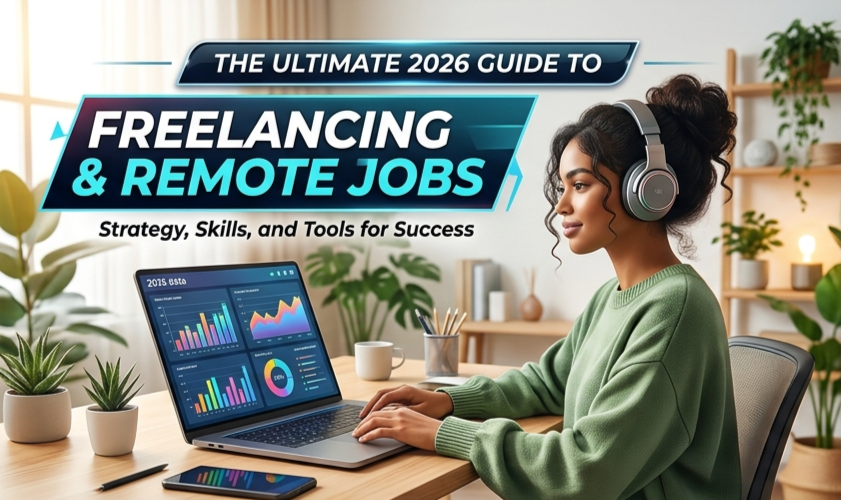
Freelancing and Remote Jobs
Welcome to the future of work. It’s 2026. The traditional 9-to-5 is no longer the default; it’s just one option among many. The global workforce has undergone a digital revolution, and the landscape of freelancing and remote jobs is more robust, structured, and competitive than ever before.
Table of Contents
- Freelancing and Remote Jobs
- Part 1: The New Landscape of Freelancing and Remote Jobs
- Strategy: Building a Resilient Remote Career
- 1. Defining Your Value Proposition
- Part 2: The Core Skills Fueling the 2026 Workforce
- The Skill Showdown: Hard vs. Soft in the Digital Age
- Technical (Hard) Skills
- Communication (Soft) Skills
- Part 3: The 2026 Toolbelt: Optimization and Efficiency
- The Essential Tech Setup for Success
- Conclusion: Mastering the Transition
Whether you’re a seasoned digital nomad refining your approach or a corporate professional looking to make the leap, this comprehensive guide will provide you with the blueprint for thriving in this new era.
Part 1: The New Landscape of Freelancing and Remote Jobs
The definition of work has been completely rewritten. By 2026, technology is seamless, and global connectivity is ubiquitous. Companies no longer ask if a role can be done remotely, but rather how best to manage it. This shift has democratized access to opportunities but has also raised the bar for entry. Success now requires a delicate balance of specialized expertise and digital fluency.
Strategy: Building a Resilient Remote Career
You cannot simply “try out” freelancing and remote jobs anymore. Success requires a deliberate strategy. In 2026, this means treating your freelance business or remote career like a startup.
1. Defining Your Value Proposition
The key is clarity. You need a rock-solid business plan

Strategic Planning for Your 2026 Freelance Business
This illustration visualizes the foundational pillars you must define:
- Niche Selection: The days of the generalist are over. Are you a “digital marketer,” or are you an “AI-driven SEO strategist for SaaS startups”? Specialization commands higher rates and cleaner client acquisition.
- Pricing Model: Stop trading time for money. Shift from hourly rates to value-based pricing or retainer models. Focus on the outcome you deliver, not the hours you clock.
- Client Acquisition: Where are your ideal clients? In 2026, cold calling is dead. Inbound marketing, targeted networking on niche platforms, and content authority are your primary tools.
- Data Analysis: Treat your career as a system. Which platforms are delivering the best leads? What is your client retention rate? (See Part 3).
Part 2: The Core Skills Fueling the 2026 Workforce
While the tools are important, your ability to apply them is everything. The skill set required for freelancing and remote jobs in 2026 has bifurcated into deep technical abilities and essential soft skills. You need a mix of hard and soft abilities.
The Skill Showdown: Hard vs. Soft in the Digital Age
The Hybrid Skills Matrix (Hard Skills VS Soft Skills)
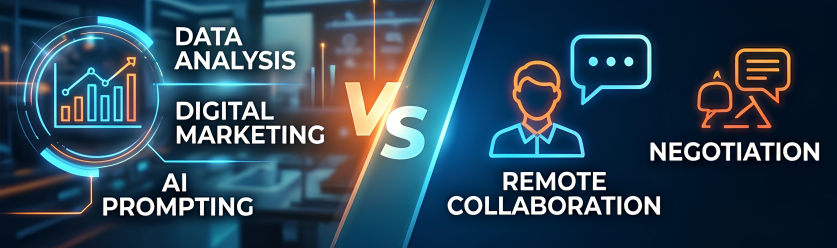
This diagram shows that you need both to survive. Here’s how they break down in 2026:
Technical (Hard) Skills
- AI Prompting: This is non-negotiable. Whether you’re a writer, developer, or marketer, the ability to effectively prompt, manage, and verify AI outputs is now a foundational requirement.
- Data Analysis: Every digital action leaves a trace. The ability to look at data—client metrics, project timelines, performance indicators—and interpret it to make better decisions is a massive competitive advantage.
- Digital Marketing & Self-Branding: As a freelancer, you are your own marketing department. You must master the platforms where your clients exist (whether LinkedIn, specialized developer forums, or niche industry hubs).
Communication (Soft) Skills
- Remote Collaboration: This is more than just using Slack. It’s the ability to manage complex, asynchronous workflows across different time zones without losing productivity or context. It requires empathy and structured communication.
- Negotiation: When you’re not in an office with a visible performance review system, you must be your own advocate. Negotiation is the skill of clearly presenting your value, setting firm boundaries, and securing rates that reflect the value you provide.
Part 3: The 2026 Toolbelt: Optimization and Efficiency
Tools are the infrastructure that makes freelancing and remote jobs possible. In 2026, the toolbelt is about interoperability and automation. You don’t just need a laptop; you need a connected system.
The Essential Tech Setup for Success
The Integrated 2026 Remote Toolkit
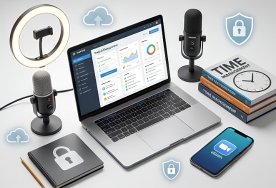
To succeed in 2026, your workspace is both physical and digital.
- Advanced Project Management: The center of Figure 3 is the laptop showing a dashboard. In 2026, your PM software is often an AI-driven system that helps predict deadlines, automate invoice generation, and manage cross-project resources.
- Seamless Global Communication: Professional-grade microphones (Figure 3), high-definition cameras, and reliable, asynchronous video messaging (like the smartphone app shown) are essential for building trust and presence when you are globally distributed.
- Security & Digital Safety: As seen in Figure 3, security is integrated into every aspect. This means dedicated hardware security keys (the small key icon), robust VPNs, and secure, encrypted cloud storage (the cloud icon). Clients in 2026 assume that security is your responsibility, not an afterthought.
Conclusion: Mastering the Transition
The future of work belongs to the adaptable. Freelancing and remote jobs in 2026 offer unparalleled freedom, but only to those willing to build a professional-grade strategic foundation, constantly upskill, and leverage robust, connected tools. Use this guide as your roadmap, and you will do more than just survive; you will find sustainable, long-term success.

No Comments